
Health anxiety therapyOut of the cycle of checking and fear.
A headache that lasts a little too long. A mole that looks different in this light. A racing heart after climbing the stairs.
Online in English, with a therapist from our team, wherever you live · Sessions in Greek are with Matina Ladikou.
Each session lasts 45 minutes and costs 70 €. All fees
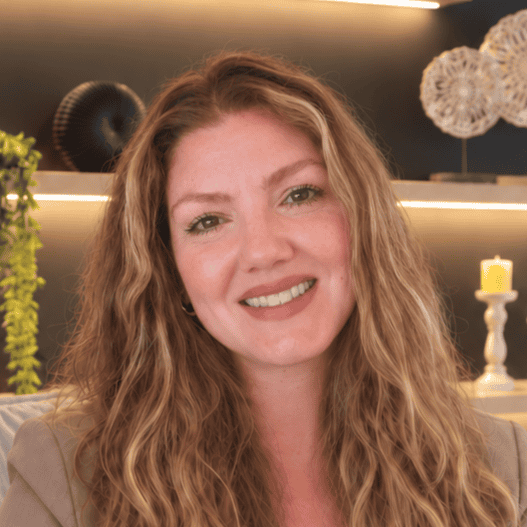 At Art of Mind, a centre founded by psychotherapist Matina Ladikou
At a glance
- Format
- Online by video on Google Meet, 45-minute sessions.
- Who you work with
- A therapist from our team, in English. In Greek, Matina Ladikou.
- Getting started
- Send an enquiry; we reply within 24 hours.
There is help
You don’t have to face this on your own
For most people these moments pass quickly; for someone with health anxiety they can trigger hours of worry, repeated checking, late-night symptom searches and visits to doctors that bring relief for a day or two before the fear comes back, sometimes attached to a new illness.
Health anxiety, once called hypochondria, is common, distressing and very treatable. At Art of Mind, a psychotherapy centre founded in Patras, Greece, in 2019, therapy for health anxiety in English takes place online by video with a therapist from our centre.
Recognising it
What is health anxiety?
The NHS describes health anxiety as spending so much time worrying that you are ill, or about getting ill, that it starts to take over your life1. In current diagnostic systems, the condition may be described as illness anxiety disorder, when the main problem is the fear of having a serious illness with few or mild symptoms3, or as somatic symptom disorder, when distressing physical symptoms are central and the worry about them is excessive4. Both share the same core: anxiety about health that is out of proportion and hard to switch off.
Health anxiety is not "imagining things". The physical sensations are real; anxiety itself produces many of them, such as palpitations, tightness, dizziness, tingling and stomach problems, which then seem to confirm the fear.
Recognising it
Signs of health anxiety
- Worrying a lot about your health, often about serious illnesses.
- Frequently checking your body for lumps, pain, tingling or changes.
- Repeatedly asking others or doctors for reassurance, but finding it does not last.
- Searching symptoms online, sometimes for hours.
- Avoiding anything to do with illness, such as news, hospitals or even medical appointments.
- Acting as if you were ill, for example avoiding exercise or certain activities.
Some people seek constant medical contact; others avoid doctors completely out of fear of what they might hear. Both can be part of health anxiety.
The cycle of checking and reassurance
Health anxiety follows a pattern that therapy aims to interrupt:
A trigger.
A sensation, a news story, someone else's illness.
A threatening interpretation.
"This could be cancer", "My heart is not normal".
Anxiety rises.
, producing more physical sensations, which seem to confirm the fear.
Safety behaviours.
Checking, searching, asking for reassurance, booking another test.
Brief relief.
, followed by new doubts ("What if they missed something?").
Each time the cycle runs, the brain learns that the sensation was dangerous and that only checking made it safe. Online searching deserves a special mention. A meta-analysis of 20 studies with more than 7,000 participants found a strong association between health anxiety and cyberchondria, meaning excessive or repeated health searches that increase distress5.
A doctor first, but with a plan
Physical symptoms deserve proper medical assessment, and therapy never replaces that. The aim is a balanced plan: an appropriate check-up with your doctor, agreement on which symptoms need medical attention, and then a reduction in extra, anxiety-driven checking. We are happy to work alongside your doctor so that medical care and therapy pull in the same direction.
Our approach
How therapy helps with health anxiety
Psychological treatment for health anxiety is well studied. A systematic review and meta-analysis of 19 randomised trials found that CBT had a moderate-to-large effect on health anxiety, with effects largely sustained 12–18 months after treatment, and that therapist-guided internet-delivered treatment had effects comparable to face-to-face therapy2. An earlier meta-analysis also found benefits for accompanying depressive symptoms6. More recent network meta-analyses have compared different psychological approaches and their components to identify which elements help most7.
Our therapists work in an integrative, evidence-informed way. For health anxiety, sessions often include:
- Understanding the cycle in your own life: triggers, thoughts, sensations and safety behaviours.
- Learning how anxiety affects the body, so that sensations become less frightening.
- Techniques from cognitive behavioural therapy, where helpful, to examine catastrophic interpretations and consider other explanations.
- Gradually reducing checking, searching and reassurance-seeking, at a pace you agree with your therapist.
- Gently approaching what you avoid, such as reading about illness or attending routine appointments.
- Living with uncertainty, since no test can ever guarantee perfect health.
- Exploring the background: illness or loss in the family, stressful periods or earlier frightening experiences that may have made you more alert to danger.
Online, by video
Online therapy for health anxiety
For people who find medical settings stressful, online sessions can be easier to start. Your therapist can also help you practise directly, for example tolerating the urge to search during the session. A meta-analysis of randomised trials found that telemedicine treatment was broadly equivalent to in-person care for anxiety, mood disorders and PTSD8.
Is it time?
When to seek help
Consider therapy if worry about your health:
- takes up a lot of your day or keeps you awake;
- continues despite normal results and medical reassurance;
- leads you to check, search or ask for reassurance repeatedly;
- leads you to avoid doctors, news, places or activities;
- is affecting your work, relationships or mood.
New, severe or changing symptoms always need medical assessment. If you have chest pain, difficulty breathing or other symptoms that could be an emergency, call 112.
Online, by video
How online therapy with us works
Send an enquiry.
Through our contact form with a short description, your time zone and preferred times. There is no need to include detailed health information.
We reply within 24 hours.
And arrange your first session with a therapist from our centre.
You meet by video.
On Google Meet, for 45 minutes, Monday to Friday between 09:00 and 21:00 Athens time.
The first session.
Covers your history and the pattern of your worry, and ends with an initial plan.
Sessions in English cost 70 € per 45-minute session. See our pricing page. For anxiety more broadly, see our anxiety therapy page.
If you need urgent help
In an emergency call 112. In Greece you can also call 1018 (suicide prevention) or 10306 (mental-health support). For helplines in your country, see findahelpline.com.
Our founder
Art of Mind, founded by Matina Ladikou
A centre where you can talk without fear of judgement, at your own pace.
Matina Ladikou, psychotherapist and founder of Art of Mind, set up the centre in Patras, Greece, in 2019. Sessions in English are with a therapist from our team; sessions in Greek are with Matina, and you can book Greek sessions directly.
We don’t promise a “guaranteed” or “instant” result; we offer a space of trust and work at your own pace.
Trained in Biothymic Psychotherapy and Clinical Hypnosis, in Mental Health Counselling and in NLP, with an MSc in Criminology from Panteion University.
About Matina and the centreNext step
Fear about your health does not have to rule your days
A short message is enough to start.
Before you start
Frequently asked questions
How do I know whether it is health anxiety or a real illness?
Only a medical assessment can tell you whether a symptom has a physical cause, so new or changing symptoms should be checked by a doctor. Health anxiety is more likely when worry continues despite reassurance and normal test results, when it takes up a lot of time and energy, and when it moves from one illness to the next.
Will therapy mean ignoring my symptoms?
No. Therapy for health anxiety does not ask you to ignore your body. It helps you agree a sensible plan for medical checks with your doctor, and then reduce the extra checking, searching and reassurance-seeking that keep the anxiety going.
Is searching symptoms online really a problem?
Occasional searching is normal. Research shows that health anxiety is strongly linked with repeated, distressing online symptom searching, often called cyberchondria. For many people, searching brings brief relief followed by more worry, which is why therapy often works on this habit.
Can health anxiety be treated online?
Yes. Research has found that internet-delivered and video-based treatment for health anxiety can work comparably to face-to-face treatment. Online sessions can also be practical if worry about illness makes visiting clinics stressful.
How much does a session cost?
Sessions in English are 70 € per 45-minute session. Full details are on our pricing page.