Panic attack therapy onlineWithout the fear of the next attack.
It often begins without warning. Your heart pounds, your chest tightens, your hands tingle and a wave of dread arrives with the certainty that something terrible is happening.
Online in English, with a therapist from our team, wherever you live · Sessions in Greek are with Matina Ladikou.
Each session lasts 45 minutes and costs 70 €. All fees
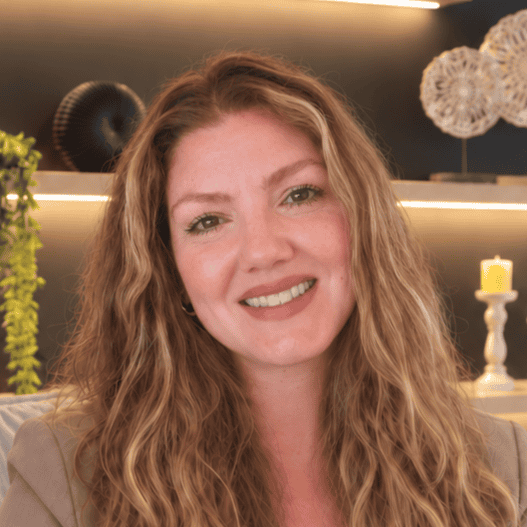 At Art of Mind, a centre founded by psychotherapist Matina Ladikou
At a glance
- Format
- Online by video on Google Meet, 45-minute sessions.
- Who you work with
- A therapist from our team, in English. In Greek, Matina Ladikou.
- Getting started
- Send an enquiry; we reply within 24 hours.
There is help
You don’t have to face this on your own
Then, just as suddenly, it passes, and leaves behind a new fear: what if it happens again?
Panic attacks are frightening, and many people go through them in silence, especially when they are living far from family or in a country where seeking help feels complicated. At Art of Mind, a psychotherapy centre founded in Patras, Greece in 2019, we offer therapy for panic attacks in English, online by video, with a therapist from our centre. This page explains what panic is, why the fear of fear keeps it going, and how therapy helps.
What a panic attack feels like
The NHS describes a panic attack as a sudden rush of intense physical and mental symptoms: a racing heartbeat, chest pain, shortness of breath, sweating, trembling, dizziness and a feeling of dread. Some people also feel detached from their body or their surroundings. Most attacks last between 5 and 20 minutes, although some people report attacks lasting up to an hour (NHS).
When attacks keep coming, or when worry about the next one starts to shape daily life, clinicians may describe this as panic disorder. In the United States, the National Institute of Mental Health estimates that about 2.7% of adults had panic disorder in the past year and about 4.7% will experience it at some point in their lives (NIMH). These are US survey figures rather than Greek data, but they show how common the experience is.
First, a medical check
Because the symptoms of panic overlap with those of heart, lung and other medical conditions, it is important not to assume. If you are having these symptoms for the first time, or you have chest pain, severe breathlessness or symptoms that feel different from before, call 112 or seek urgent medical care. A doctor can examine you and rule out physical causes.
Only once that has happened does an important reassurance apply: panic attacks, frightening as they are, are not dangerous in themselves and rarely lead to hospital admission (NHS). Holding both truths together, taking symptoms seriously while learning not to fear them, is part of what therapy helps with.
Recognising it
Why panic keeps coming back
Panic often works like an oversensitive smoke alarm, sounding at burnt toast as if the house were on fire. A normal body sensation, such as a skipped beat after coffee or breathlessness on the stairs, is read as a sign of danger. That interpretation triggers the body's alarm response, which produces more sensations, which feel like further proof that something is wrong. Within seconds, the loop can build into a full attack.
Over time, three things tend to keep the cycle going:
Watching the body
You become alert to every flutter or twinge, which makes sensations more noticeable and more alarming.
Avoidance
You stop exercising, avoid crowded places, public transport or being far from home, and the world gradually shrinks.
Safety behaviours
Carrying water, sitting near exits or never going out alone may feel protective, yet they prevent the brain from learning that you can cope without them.
None of this means you are weak or imagining things. The alarm system is trying to protect you; it has simply become too quick to fire.
Our approach
How therapy helps with panic
UK guidance from NICE describes psychological therapy, medication and self-help as treatments with an evidence base for panic disorder, and recommends that people with moderate to severe panic disorder be considered for cognitive behavioural therapy (NICE CG113). The NHS likewise lists CBT as a main treatment, with medication prescribed by a doctor as a further option (NHS).
Our therapists work in an evidence-informed, integrative way, drawing on CBT techniques where helpful. Depending on your situation, therapy may include:
Understanding your panic cycle
Mapping a recent attack step by step: the trigger, the sensation, the thought, the fear, and what you did next.
Rethinking the catastrophic reading
Looking closely at what you believe is happening during an attack and weighing it against what you know.
Breathing and grounding
Learning ways to steady yourself that support, rather than replace, the deeper work.
Becoming less afraid of sensations
After a medical check, and only with your agreement, your therapist may guide you in session through gentle exercises that bring on mild, harmless sensations, so your body can learn they are not a threat. This is something we do together in therapy, carefully planned, and not something to attempt alone.
Reclaiming avoided places
Step by step, returning to the activities and places panic has taken from you.
We do not promise that you will never feel panic again, and results vary. The goal is that panic loses its grip, so that if an attack does come, it no longer runs your life. If medication might help, we encourage you to talk to your doctor, and we work alongside doctors and psychiatrists when useful.
Online, by video
How online therapy with us works
Tell us what you need.
Use our enquiry form to share a few lines about what you are looking for, your time zone and when you are free. Please do not include detailed health information. We reply within 24 hours.
Your sessions.
Sessions in English are with a therapist from our centre, online on Google Meet, Monday to Friday between 09:00 and 21:00 Athens time. Working from home can be a relief when travelling feels risky.
The first session.
Your therapist will ask about your history, when the attacks started, what they are like and what you have stopped doing because of them. Together you agree a starting plan, including whether a medical check is still needed.
Regular sessions.
Each session lasts 45 minutes and costs 70 €. See pricing for details.
Evidence supports working online: a 2023 meta-analysis of 20 randomised trials found telemedicine comparable with in-person treatment for anxiety, mood and post-traumatic stress conditions in terms of efficacy, satisfaction and drop-out (Shaker et al., 2023). See our online therapy page for the practical details.
Is it time?
When to seek help
Call 112 or see a doctor urgently if you have chest pain, severe breathlessness, fainting or symptoms you have never had before. Consider therapy if:
- panic attacks keep returning, or you live in fear of the next one;
- you are avoiding places, travel, exercise or being alone;
- you are relying on alcohol or other substances to calm down;
- panic is affecting your work, relationships or mood.
If you feel hopeless or have thoughts of harming yourself, please seek help immediately. Online therapy is not an emergency service.
If you need urgent help. In an emergency call 112. In Greece you can also call 1018 (suicide prevention) or 10306 (mental-health support). For helplines in your country, see findahelpline.com.
If you need urgent help
In an emergency call 112. In Greece you can also call 1018 (suicide prevention) or 10306 (mental-health support). For helplines in your country, see findahelpline.com.
Our founder
Art of Mind, founded by Matina Ladikou
A centre where you can talk without fear of judgement, at your own pace.
Matina Ladikou, psychotherapist and founder of Art of Mind, set up the centre in Patras, Greece, in 2019. Sessions in English are with a therapist from our team; sessions in Greek are with Matina, and you can book Greek sessions directly.
We don’t promise a “guaranteed” or “instant” result; we offer a space of trust and work at your own pace.
Trained in Biothymic Psychotherapy and Clinical Hypnosis, in Mental Health Counselling and in NLP, with an MSc in Criminology from Panteion University.
About Matina and the centreNext step
Enquire about a session
Panic can make the world feel smaller. Therapy is about making it bigger again, one step at a time. Send us a short message and we will reply within 24 hours.
Related pages: anxiety therapy · social anxiety therapy · online therapy · pricing
Before you start
Frequently asked questions
How do I know it is a panic attack and not something physical?
You cannot always tell from the symptoms alone, because chest pain, breathlessness and a racing heart can also come from medical conditions. If it is your first episode, or you have chest pain or severe breathlessness, call 112 or see a doctor straight away. Once a doctor has ruled out a physical cause, therapy can help you work with the panic itself.
Are panic attacks dangerous?
After a medical check has ruled out other causes, the NHS notes that panic attacks are not dangerous in themselves, even though they feel frightening. The difficulty is that fear of the next attack can lead to avoidance that narrows your life, which is what therapy aims to change.
How long does a panic attack last?
According to the NHS, most panic attacks last between 5 and 20 minutes, although some people report attacks lasting up to an hour. How often they happen varies widely from person to person.
Can online therapy help with panic attacks?
Research comparing video therapy with face-to-face therapy for anxiety, mood and trauma-related conditions has found broadly comparable results. Being able to work on panic from home, or wherever you feel steady, is often helpful when travelling to appointments feels hard.
Will therapy involve bringing on the symptoms?
Sometimes, gently and only with your agreement. After a medical check, part of the work may be done together in session, where your therapist helps you become less afraid of harmless body sensations. This is planned carefully and is not something to try on your own from a website.