
Relationship counselling onlineSee clearly what keeps repeating.
Some of the hardest problems in life are not inside us but between us.
Online in English, with a therapist from our team, wherever you live · Sessions in Greek are with Matina Ladikou.
Each session lasts 45 minutes and costs 70 €. All fees
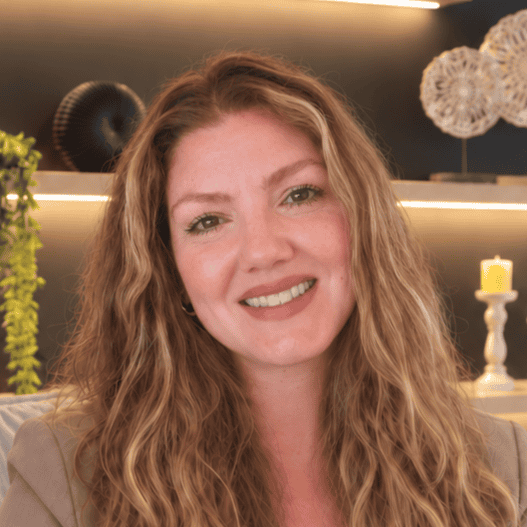 At Art of Mind, a centre founded by psychotherapist Matina Ladikou
At a glance
- Format
- Online by video on Google Meet, 45-minute sessions.
- Who you work with
- A therapist from our team, in English. In Greek, Matina Ladikou.
- Getting started
- Send an enquiry; we reply within 24 hours.
There is help
You don’t have to face this on your own
An argument with a partner that keeps resurfacing in a slightly different form; a parent whose phone calls leave you tense for the rest of the day; a friendship that has slowly turned into an obligation; or the particular loneliness of building a life in a new country, where the people who know you best are a time zone away. These situations can take up an enormous amount of emotional space, and yet they are often the last things people feel entitled to seek help for.
At Art of Mind, a psychotherapy centre founded in Patras, Greece in 2019, our therapists offer one-to-one relationship counselling in English, online by video. This page is for individuals who want to understand and change what happens in their relationships, whether or not the other people involved are ready to take part.
Recognising it
Why relationships affect us so deeply
Humans are built for connection, and when our close relationships are strained the effects rarely stay contained. A difficult period with a partner can show up as poor sleep, irritability at work or a constant background worry. Family conflict can pull us back into old roles we thought we had outgrown, so that a confident adult suddenly feels like a younger version of themselves at the dinner table. And the absence of connection matters as much as conflict: in June 2025 the World Health Organization reported that loneliness affects about one in six people globally and is linked to depression, anxiety and thoughts of self-harm (WHO, 2025).
None of this means that a struggling relationship is a sign that something is wrong with you. Relationships involve at least two people, each carrying their own history, stress and expectations. Counselling simply gives you a calmer place to look at your part in the pattern, which is the only part you can directly change.
Common relationship difficulties we work with
People bring a wide range of concerns to relationship counselling. Some of the most common are:
Recurring conflict with a partner
The same argument returning again and again, or disagreements that escalate quickly and leave both people hurt.
Distance and disconnection
Feeling more like flatmates than partners, or noticing that you no longer talk about anything that matters.
Trust and jealousy
Anxiety about the relationship, difficulty trusting after a breach, or a pattern of insecurity that follows you from one relationship to another.
Family tension
Strained relationships with parents, siblings or in-laws; feeling caught between your partner and your family; or the guilt of setting a boundary for the first time.
Life changes
Becoming a parent, moving countries, caring for an ageing relative, or one partner relocating for work, all of which can unsettle a relationship that once felt stable.
Loneliness and friendship
Struggling to build new connections abroad, or friendships that have become one-sided.
If you and your partner want to work on the relationship together, our couples therapy and marriage counselling pages explain how joint sessions work.
Recognising it
Patterns that repeat, and why
Many people notice that their difficulties are not random. They find themselves drawn into the same kind of argument, pulling away whenever someone gets close, or always being the one who smooths things over. These patterns usually made sense at some point in life; they may have been ways of staying safe, keeping the peace or earning approval. The trouble is that a strategy that once protected us can later get in the way of the closeness we want.
Counselling helps you notice these patterns as they happen, understand where they come from, and practise responding differently. That might mean learning to say what you need without blaming, tolerating a disagreement without rushing to fix it, or recognising when an old fear is colouring a new situation.
What the research says
What research tells us
Relationship-focused therapy has a solid research base. NHS guidance on depression lists interpersonal therapy, which focuses on relationships and difficulties with other people, among its recommended talking therapies, and includes behavioural couples therapy when relationship problems contribute to low mood (NHS). A network meta-analysis of 331 randomised trials found that interpersonal therapy, alongside other main forms of psychotherapy, was more effective than usual care for adult depression, with few differences between the main approaches (Cuijpers et al., 2021).
For couples who attend together, a meta-analysis of 33 randomised trials with 2,730 participants found that two established couples approaches produced medium improvements in relationship satisfaction at the end of therapy and smaller gains at six months, while noting possible publication bias (Rathgeber et al., 2019). These findings are a guide, not a promise.
Our approach
How our therapists work
Our therapists use an evidence-informed, integrative approach, which means they draw on more than one method and adapt it to you. In relationship counselling this often includes:
Mapping the situation
Who is involved, what tends to trigger difficulties, and what you have already tried.
Understanding your part
Gently exploring your reactions, expectations and the history behind them, without blame.
Communication skills
Practising clear, calm ways of expressing needs and listening, and drawing on CBT techniques where helpful to catch the thoughts that fuel escalation.
Boundaries
Working out what you are and are not willing to accept, and how to say so.
Decisions
Supporting you to think through difficult choices without your therapist taking sides.
We cannot promise a particular outcome for a relationship, because other people make their own choices. What counselling can offer is greater clarity, steadier responses and a stronger sense of what you want.
Online, by video
Starting online sessions with us
Step one: get in touch
Send a short message through our enquiry form with your time zone and the times that usually suit you. There is no need to describe your situation in detail at this stage. We reply within 24 hours.
Step two: meet your therapist
Your sessions in English will be with a therapist from our centre, online via Google Meet, on weekdays between 09:00 and 21:00 Athens time.
Step three: the first conversation
Your therapist will ask about your background, the relationships that concern you and what you hope will be different. By the end, you will agree on an initial plan together.
Step four: regular sessions
Each session lasts 45 minutes. Individual sessions cost 70 € per 45-minute session; see pricing.
Research on video therapy is encouraging: a 2021 meta-analysis found that live psychotherapy by video differed negligibly in outcome from in-person therapy (Fernandez et al., 2021), and a 2023 meta-analysis of 20 trials found telemedicine comparable to in-person treatment across mood, anxiety and trauma-related conditions (Shaker et al., 2023). Read more on our online therapy page.
Is it time?
When to seek help
It may be time to talk to someone if:
- the same conflict keeps returning and leaves you exhausted or hopeless;
- you feel anxious, low or on edge because of a relationship;
- you are withdrawing from friends or family to avoid tension;
- a family situation is affecting your sleep, work or health;
- you feel isolated and unsure how to rebuild connection.
If you are afraid of a partner or family member, or someone is hurting you, your safety comes first. Contact emergency services, and seek specialist support for domestic abuse where you live. Online counselling is not an emergency service.
If you need urgent help. In an emergency call 112. In Greece you can also call 1018 (suicide prevention) or 10306 (mental-health support). For helplines in your country, see findahelpline.com.
If you need urgent help
In an emergency call 112. In Greece you can also call 1018 (suicide prevention) or 10306 (mental-health support). For helplines in your country, see findahelpline.com.
Our founder
Art of Mind, founded by Matina Ladikou
A centre where you can talk without fear of judgement, at your own pace.
Matina Ladikou, psychotherapist and founder of Art of Mind, set up the centre in Patras, Greece, in 2019. Sessions in English are with a therapist from our team; sessions in Greek are with Matina, and you can book Greek sessions directly.
We don’t promise a “guaranteed” or “instant” result; we offer a space of trust and work at your own pace.
Trained in Biothymic Psychotherapy and Clinical Hypnosis, in Mental Health Counselling and in NLP, with an MSc in Criminology from Panteion University.
About Matina and the centreNext step
Enquire about a session
You do not have to have everything worked out before you reach out. Tell us briefly what you are looking for and when you are available, and we will reply within 24 hours.
Related pages: couples therapy · marriage counselling · divorce counselling · therapy for expats
Before you start
Frequently asked questions
Can I have relationship counselling on my own, without my partner?
Yes. This page is about one-to-one counselling, and many people come on their own. Working individually lets you look at your own patterns, needs and choices, whatever your partner or family decide to do. If you both want to attend together, see our couples therapy page.
What kinds of relationship problems can you help with?
People come to us with recurring arguments with a partner, distance or loss of trust, difficulties with parents or siblings, tension with in-laws, friendships that have become painful, loneliness after a move abroad, and patterns that keep repeating from one relationship to the next. You do not need a precise label to start.
Will the therapist tell me whether to stay or leave?
No. Our role is to help you understand what is happening, what you want and what is possible, so that you can make your own decisions with a clearer head. Your therapist will not take sides or make the decision for you.
Does online counselling work for relationship difficulties?
Research on video-delivered therapy is encouraging. A 2021 meta-analysis found outcomes of live video psychotherapy differed negligibly from in-person therapy, and a 2023 meta-analysis of 20 trials reached a similar conclusion for mood, anxiety and trauma-related difficulties, which often sit alongside relationship stress.
How much does it cost?
Individual sessions in English cost 70 € per 45-minute session. You can find the details on our pricing page, and we can answer any questions when you enquire.