
Anxiety therapy onlineFind calm and control again.
Anxiety rarely announces itself politely. It can look like lying awake running through every way tomorrow could go wrong, a tight chest before a meeting, checking your phone for bad news, or cancelling plans because the thought of going out feels like too much.
Online in English, with a therapist from our team, wherever you live · Sessions in Greek are with Matina Ladikou.
Each session lasts 45 minutes and costs 70 €. All fees
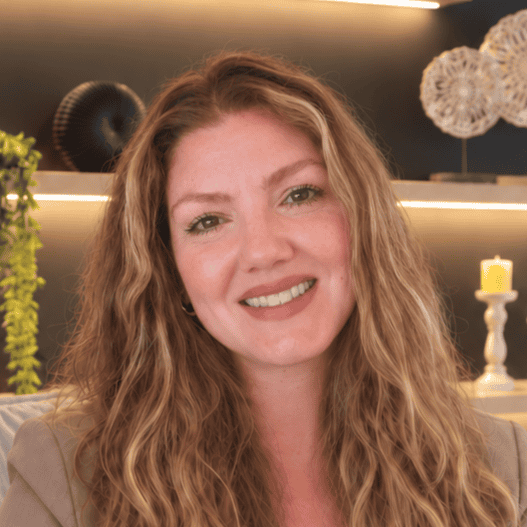 At Art of Mind, a centre founded by psychotherapist Matina Ladikou
At a glance
- Format
- Online by video on Google Meet, 45-minute sessions.
- Who you work with
- A therapist from our team, in English. In Greek, Matina Ladikou.
- Getting started
- Send an enquiry; we reply within 24 hours.
There is help
You don’t have to face this on your own
Stress can feel similar: a sense of being permanently switched on, short-tempered and tired at the same time. Both are human responses that exist to protect us, but when they stay on for too long they start to shape everything else.
The good news is that anxiety is one of the most researched and most treatable mental health difficulties. At Art of Mind, a psychotherapy centre founded in Patras, Greece, in 2019, therapy for anxiety and stress in English takes place online by video with a therapist from our centre.
Recognising it
Anxiety, stress or something else?
Stress is a state of worry or mental tension caused by a difficult situation; it is a natural response that helps us deal with challenges and threats, and everyone experiences it to some degree5. It usually has a clear cause and eases when the pressure lifts.
Anxiety is a feeling of fear or unease that everyone has at times6. It becomes a problem when it is intense, frequent or out of proportion to the situation, or when it lingers long after the trigger has passed. Anxiety can take several forms:
Generalised anxiety
Worrying about many different things most days, finding it hard to stop. See our page on generalised anxiety disorder.
Panic attacks
Sudden waves of intense fear with a racing heart, breathlessness or dizziness; see panic attack therapy.
Social anxiety
Fear of being judged, embarrassed or watched; see social anxiety therapy.
Health anxiety
Persistent worry about having a serious illness; see health anxiety therapy.
Phobias
Intense fear of specific things or situations; see phobia therapy.
Obsessive thoughts and compulsions
See OCD therapy.
You do not need to know which label fits before you start. Making sense of your particular pattern is part of the first sessions.
Recognising it
How anxiety shows up
Anxiety affects the whole person:
In the body
Racing heart, tight chest, shallow breathing, muscle tension, stomach problems, headaches, sweating, trouble sleeping.
In the mind
Constant "what ifs", difficulty concentrating, expecting the worst, feeling on edge or detached.
In behaviour
Avoiding situations, seeking reassurance, over-preparing, checking, procrastinating, or using alcohol to take the edge off.
These reactions are the body's alarm system doing its job, only too often and too loudly. Understanding this does not switch anxiety off, but it often makes it less frightening.
Recognising it
The anxiety cycle, and why avoidance keeps it going
Most anxiety follows a recognisable cycle. A trigger leads to a threatening thought ("I'll make a fool of myself", "something is wrong with my heart"); the body responds with alarm; and we do something to feel safer, such as leaving, avoiding, checking or seeking reassurance. The relief is real but short-lived, and it teaches the brain that the situation really was dangerous, so the next time anxiety arrives sooner and stronger.
Therapy works by helping you see this cycle clearly and then loosening it at several points: noticing and questioning catastrophic thoughts, calming the body's alarm, and gradually approaching what you have been avoiding so that your brain can learn, through experience, that you can cope.
Our approach
How our therapists work with anxiety
Our therapists work in an integrative, evidence-informed way. For anxiety, this commonly includes:
- Understanding your pattern: what triggers your anxiety, what you tell yourself, what you do to cope and what that costs you.
- Techniques from cognitive behavioural therapy, where helpful, to notice and test anxious predictions rather than accept them as facts. A meta-analysis of placebo-controlled trials found that CBT had moderate effects on anxiety-related disorders, with large effects for generalised anxiety disorder2.
- Gradual exposure: planned, step-by-step approach to avoided situations, at a pace you agree with your therapist.
- Working with the body: breathing and relaxation skills to bring the nervous system down when it is on high alert. The NHS describes simple breathing exercises for stress that many people find helpful7.
- Emotions and context: what the anxiety might be protecting you from, and pressures in your work, relationships or history that feed it.
Clinical guidance follows a similar logic. For generalised anxiety disorder, the NICE guideline recommends a stepped approach in which education and self-help come first and, if anxiety persists or significantly affects daily life, a high-intensity psychological intervention such as CBT or applied relaxation, or medication, is offered3.
Something to try now
Things you can try now
While therapy is the most reliable way to change entrenched anxiety, some steps help many people in the meantime:
- Slow your breathing, especially the out-breath, for a few minutes when you notice tension rising.
- Name the worry and write it down, then ask: what is the evidence, and what would I tell a friend?
- Schedule "worry time": a fixed 15 minutes a day to worry deliberately, postponing worries outside that time.
- Reduce caffeine and alcohol, both of which can amplify anxiety and disturb sleep.
- Move your body every day, even a short walk.
- Take one small step towards something you have been avoiding, rather than waiting until you feel ready.
Online, by video
Does online therapy work for anxiety?
For many people with anxiety, online sessions remove barriers such as travelling to an unfamiliar place or sitting in a waiting room. A 2021 meta-analysis found that video therapy produced large improvements, with anxiety among the targets showing effect sizes near 1.0, and negligible differences from in-person therapy4. Your therapist can also use the online format creatively, for example by practising a feared phone call or video meeting during the session.
Is it time?
When to seek help
Consider therapy if anxiety or stress:
- has lasted several weeks or keeps returning;
- leads you to avoid work, social events, travel or other things that matter;
- is affecting your sleep, relationships or health;
- comes with panic attacks;
- is leading you to rely on alcohol, sleeping tablets or other substances.
Some physical conditions can cause anxiety-like symptoms. If you experience chest pain, breathlessness or palpitations for the first time, or symptoms that feel different from usual, seek medical help first; in an emergency call 112. We are happy to work alongside your doctor or psychiatrist where that helps.
Online, by video
How online therapy with us works
Send an enquiry.
Through our contact form with a few words about what you are looking for, your time zone and preferred times. Please keep health details brief.
We reply within 24 hours.
And arrange your first session with a therapist from our centre.
You meet by video.
On Google Meet, for 45 minutes, Monday to Friday between 09:00 and 21:00 Athens time.
In the first session.
You talk through your history and current difficulties, and agree an initial plan.
Sessions in English cost 70 € per 45-minute session. See our pricing page for details.
If you need urgent help
In an emergency call 112. In Greece you can also call 1018 (suicide prevention) or 10306 (mental-health support). For helplines in your country, see findahelpline.com.
Our founder
Art of Mind, founded by Matina Ladikou
A centre where you can talk without fear of judgement, at your own pace.
Matina Ladikou, psychotherapist and founder of Art of Mind, set up the centre in Patras, Greece, in 2019. Sessions in English are with a therapist from our team; sessions in Greek are with Matina, and you can book Greek sessions directly.
We don’t promise a “guaranteed” or “instant” result; we offer a space of trust and work at your own pace.
Trained in Biothymic Psychotherapy and Clinical Hypnosis, in Mental Health Counselling and in NLP, with an MSc in Criminology from Panteion University.
About Matina and the centreNext step
A calmer relationship with anxiety is possible
You do not have to wait until the anxiety is unbearable. A short message is enough to start.
Before you start
Frequently asked questions
What is the difference between stress and anxiety?
Stress is usually a response to a specific pressure, such as a deadline or a move, and tends to ease when the situation changes. Anxiety can continue even when there is no clear threat, or be out of proportion to it, and often shows up as constant worry, tension and physical symptoms. The two overlap, and therapy can help with both.
Is online therapy effective for anxiety?
Research suggests it can be. Meta-analyses comparing video therapy with in-person sessions have found broadly similar outcomes for anxiety disorders. Many people also find it easier to talk from a familiar environment.
Do you use CBT for anxiety?
Our therapists work in an integrative, evidence-informed way and draw on CBT techniques where they help, for example to question catastrophic thoughts or to approach situations you have been avoiding step by step. They combine these with work on emotions, the body and the wider context of your life.
Will I need medication?
Many people with anxiety improve with psychological therapy alone; others benefit from medication as well. Decisions about medication are made with a doctor or psychiatrist. If you are taking medication or considering it, we are happy to work alongside your doctor.
How long does therapy for anxiety take?
It varies. Some people notice meaningful change within a couple of months of weekly sessions; long-standing or more complex anxiety may need longer. Your therapist will suggest a realistic plan after the first session and review it with you regularly.
How much does a session cost?
Sessions in English are 70 € per 45-minute session. Full details are on our pricing page.