
Social anxiety therapy onlineFeel free again among other people.
You rehearse the sentence three times before saying it, and replay it for hours afterwards. You arrive late to avoid the small talk, leave early to avoid the goodbyes, and let calls go to voicemail because answering feels like stepping onto a stage.
Online in English, with a therapist from our team, wherever you live · Sessions in Greek are with Matina Ladikou.
Each session lasts 45 minutes and costs 70 €. All fees
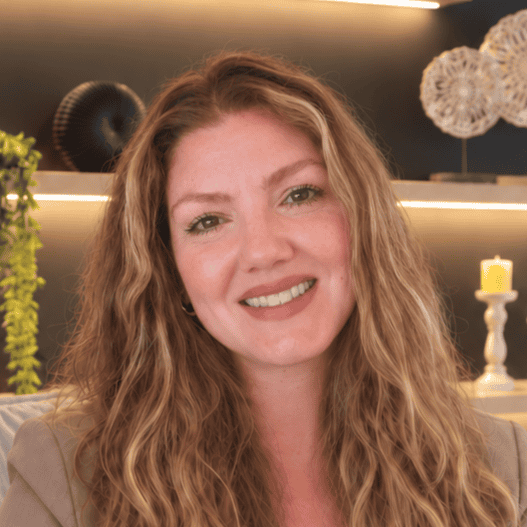 At Art of Mind, a centre founded by psychotherapist Matina Ladikou
At a glance
- Format
- Online by video on Google Meet, 45-minute sessions.
- Who you work with
- A therapist from our team, in English. In Greek, Matina Ladikou.
- Getting started
- Send an enquiry; we reply within 24 hours.
There is help
You don’t have to face this on your own
From the outside, people may simply see someone quiet. From the inside, it can feel exhausting.
Social anxiety is one of the most common anxiety problems, and one of the most treatable. At Art of Mind, a psychotherapy centre founded in Patras, Greece in 2019, we offer therapy for social anxiety in English, online by video, with a therapist from our centre. This page explains what social anxiety is, what tends to keep it going, and how therapy can help you take back the situations it has quietly taken from you.
Recognising social anxiety
The NHS describes social anxiety, sometimes called social phobia, as a long-term and overwhelming fear of social situations that goes beyond ordinary shyness (NHS). It can show up in obvious moments, such as giving a presentation, and in quieter ones that most people barely notice: ordering in a café, making a phone call, eating in front of colleagues, or joining a conversation already in progress.
Common experiences include:
Fear of being judged
A strong sense that others are noticing and evaluating you, often negatively.
Fear of visible signs of anxiety
Worry about blushing, sweating, trembling or your voice shaking, and about people seeing it.
Avoidance and escape
Steering clear of parties, meetings or calls, or finding reasons to leave early.
Before-and-after worry
Dreading an event for days, then going over every word afterwards.
Physical symptoms
Nausea, a racing heart, sweating or shaking, and sometimes panic attacks.
Social anxiety often travels with low self-esteem, and it can sit alongside depression, generalised anxiety or panic (NHS). For people who have moved abroad, it may intensify. Speaking in a second language, decoding unfamiliar social rules and starting a network from scratch can all feed the fear of getting it wrong.
How common it is
Social anxiety is widespread. In the United States, survey data reported by the National Institute of Mental Health estimate that about 7.1% of adults had social anxiety disorder in the past year and about 12.1% will experience it at some point in their lives (NIMH). These are US figures, not Greek or European estimates, but they give a sense of scale: if you recognise yourself here, you are far from alone.
Recognising it
Why the fear keeps itself going
Social anxiety tends to be held in place by a few understandable habits. Avoidance brings immediate relief, so the brain learns that the situation was dangerous and that escaping it was the right call. When you cannot avoid, you may rely on "safety behaviours": rehearsing scripts, avoiding eye contact, holding a glass to hide shaking hands, or staying silent so as not to say the wrong thing. These feel protective, yet they often make interactions harder and prevent you from discovering that things might have gone well without them.
Attention also plays a part. When anxious, people tend to turn their focus inwards, monitoring their own face, voice and body, which makes symptoms feel more noticeable and leaves less attention for the conversation itself. Afterwards, the mind reviews the event with a harsh editor, selecting every awkward moment and skipping the rest. None of this is a character flaw. These are learned patterns, and learned patterns can change.
What the research says
What helps: the evidence
The most consistent evidence for social anxiety concerns cognitive behavioural approaches. NICE, the UK guideline body, recommends offering adults individual cognitive behavioural therapy that has been developed specifically for social anxiety disorder, and advises against routinely offering group therapy in preference to individual work (NICE CG159). The NHS describes CBT as the best treatment, with guided self-help and, in some cases, medication prescribed by a doctor as further options (NHS).
Our therapists work in an evidence-informed, integrative way, drawing on CBT techniques where helpful. In practice, therapy for social anxiety often includes:
Building a shared map
Identifying the situations you fear, what you predict will happen, and the safety behaviours you use to cope.
Shifting attention outwards
Practising focusing on the conversation and the other person rather than on monitoring yourself.
Testing predictions
Planning small experiments, then comparing what you feared with what actually happened.
Gradual exposure
Approaching avoided situations step by step, starting with ones that feel challenging but manageable.
Softening the inner critic
Working on the harsh post-event review and the beliefs about yourself that sit underneath it.
We do not promise that anxiety will disappear entirely, and progress varies from person to person. The aim is that fear stops deciding what you can and cannot do. If medication might be useful, that is a conversation for your doctor, and we work alongside doctors and psychiatrists when it helps.
Online, by video
How online therapy with us works
Send a short enquiry.
You do not need to phone anyone. Use our enquiry form to tell us briefly what you are looking for, your time zone and your usual availability. Please keep detailed health information out of the form. We reply within 24 hours.
Meet your therapist by video.
Sessions in English are with a therapist from our centre, held on Google Meet from wherever you feel comfortable. Appointments are available Monday to Friday, 09:00 to 21:00 Athens time.
A first session about you.
We go through your history, how social anxiety shows up for you now and what you would like to be able to do. Together we agree an initial plan.
Regular 45-minute sessions.
Most people begin weekly. Each session costs 70 €, and between sessions you may agree small practice steps with your therapist. See pricing for details.
Many people with social anxiety find starting online a welcome first step. The evidence supports it: a meta-analysis found that live psychotherapy by video produced substantial improvement and differed negligibly from in-person treatment, with the strongest effects in anxiety, depression and post-traumatic stress (Fernandez et al., 2021), and a 2023 meta-analysis of 20 trials reached a similar conclusion (Shaker et al., 2023). Read more on our online therapy page.
Is it time?
When to seek help
It may be time to talk to someone if:
- you regularly avoid work, study or social opportunities because of fear;
- worry before and after social events takes up a lot of your time;
- you are using alcohol or other substances to get through social situations;
- you feel increasingly isolated or low;
- the fear is affecting your career, relationships or wellbeing.
If you are feeling hopeless or having thoughts of harming yourself, please seek urgent help rather than waiting for a therapy appointment. Online therapy is not an emergency service.
If you need urgent help. In an emergency call 112. In Greece you can also call 1018 (suicide prevention) or 10306 (mental-health support). For helplines in your country, see findahelpline.com.
If you need urgent help
In an emergency call 112. In Greece you can also call 1018 (suicide prevention) or 10306 (mental-health support). For helplines in your country, see findahelpline.com.
Our founder
Art of Mind, founded by Matina Ladikou
A centre where you can talk without fear of judgement, at your own pace.
Matina Ladikou, psychotherapist and founder of Art of Mind, set up the centre in Patras, Greece, in 2019. Sessions in English are with a therapist from our team; sessions in Greek are with Matina, and you can book Greek sessions directly.
We don’t promise a “guaranteed” or “instant” result; we offer a space of trust and work at your own pace.
Trained in Biothymic Psychotherapy and Clinical Hypnosis, in Mental Health Counselling and in NLP, with an MSc in Criminology from Panteion University.
About Matina and the centreNext step
Enquire about a session
Reaching out can be the hardest part when social anxiety is the problem, so we have kept it simple: a short written enquiry, no phone call needed. Tell us what you are looking for and we will reply within 24 hours.
Related pages: anxiety therapy · panic attack therapy · therapy for expats · pricing
Before you start
Frequently asked questions
Is social anxiety just shyness?
No. Many people are shy and still manage the things they want to do. Social anxiety is a persistent, overwhelming fear of being judged or embarrassed that leads you to dread or avoid everyday situations such as meetings, phone calls, eating in front of others or speaking up. When it starts to shape your choices about work, study or friendships, it is worth getting support.
Is it easier to start therapy online if I have social anxiety?
For many people, yes. Joining a video call from a familiar room can feel less daunting than walking into a waiting room. Research suggests video therapy is broadly as effective as therapy delivered face to face, so starting online is a reasonable choice rather than a compromise.
Will I have to do things that scare me?
Gradually facing feared situations is part of how social anxiety eases, but nothing is forced. You and your therapist plan small, manageable steps together, and you decide the pace. Preparation and reflection happen in session, so you are never simply thrown in at the deep end.
Can social anxiety improve without treatment?
It sometimes eases with age, but NHS guidance notes that for many people it does not go away on its own. Avoidance tends to keep the fear alive, which is why structured support often helps.
What does a session cost?
Sessions in English cost 70 € per 45-minute session. You can find full details on our pricing page, and you can enquire first with any questions before deciding.